Posts

solar new training

Ex10S7346 Ex10S7347 Ex10S7348 Ex10S7349 Ex10S7350 Ex10S7351 Ex10S7352 Ex10S7353 Ex10S7354 Ex10S7355 Ex10S7356 Ex10S7357 Ex10S7358 Ex10S7359 Ex10S7360 Ex10S7361 Ex10S7362 Ex10S7363 Ex10S7364 Ex10S7365 Ex10S7366 Ex10S7367 Ex10S7368 Ex10S7369 Ex10S7370 Ex10S7371 Ex10S7372 Ex10S7373 Ex10S7374 Ex10S7375 Ex10S7376 Ex10S7377 Ex10S7378 Ex10S7379 Ex10S7380 Ex10S7381 Ex10S7382 Ex10S7383 Ex10S7384 Ex10S7385 Ex10S7386 Ex10S7387 Ex10S7388 Ex10S7389 Ex10S7390 Ex10S7391 Ex10S7392 Ex10S7393 Ex10S7394 Ex10S7395 Ex10S7396 Ex10S7397 Ex10S7398 Ex10S7399 Ex10S7400 Ex10S7401 Ex10S7402 Ex10S7403 Ex10S7404 Ex10S7405 Ex10S7406 Ex10S7407 Ex10S7408 Ex10S7409 Ex10S7410 Ex10S7411 Ex10S7412 Ex10S7413 Ex10S7414 Ex10S7415 Ex10S7416 Ex10S7417 Ex10S7418 Ex10S7419 Ex10S7420 Ex10S7421 Ex10S7422 Ex10S7423 Ex10S7424 Ex10S7425 Ex10S7426 Ex10S7427 Ex10S7428 Ex10S7429 Ex10S7430 Ex10S7431 Ex10S7432 Ex10S7433 Ex10S7434 Ex10S7435 Ex10S7436...

electric vehicle course

Image
  EV EVSE Business Management Course for Entrepreneurs India to become a manufacturing hub for electric vehicles in five years. Indian EV industry to represent Rs 500 billion opportunity by 2025. This Techno Commercial course: Throughout this training session, AEVT bridges the needs of startups so that candidate can understand the technology from basic of EV to EVSE equipment like Lithium-ion battery, Battery pack assembly process, EV Motor, Charger, charging station development and all others parts/ equipment's calculation, selection, building a Legal Foundation, Understanding Finance Basics, Business Planning and Fundraising. Reference:  http://aevt.org/courses/electric-vehicle-technology-business-management.php 

Many companies offering to end consumers include both

Image
  one kilowatt of solar system costs less than a premium mobile phone   "We are encouraging rooftop solar, because, the its opportunities to creates jobs, when compared with utility scale solar.  whole eco-system of suppliers, manufacturers of modules, structures, inverters and more have adapted to the business opportunity." - says Expert at Institute of Solar Technology.  Solar Adoption Experience For Consumers  - Solar is not only environmentally responsible, but the investment too breaks-even within 3 to 4 years. The system yields high returns on investment and is commercially viable. with the help of net-metering, the power supply is uninterrupted which in turn reduces the cost of the overall system in the longer run. one kilowatt of solar system costs less than a premium mobile phone and in addition, it’s an investment into green energy and the saving in electricity bill continues for 25 years. Many companies offering to end consumers include both loans wit...

based farming are a detriment to farmers

Image
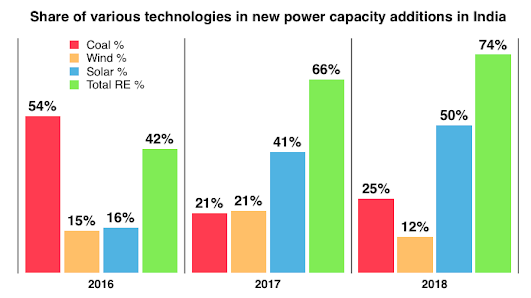
  The solar industry in India   T he country's solar industry is showing signs of recovery with increased activity compared to the previous quarter while 2020  worst years for solar in India as COVID-19 took a heavy toll on the industry,  the industry still has a long way to go. However, the market is almost back on its feet, and the mood is upbeat as the industry heads to 2021 - one of the best years foretasted for the sector," said Raj Prabhu, CEO of Mercom Capital Group. India,  the third-largest solar market in the world, India has witnessed a dip in terms of capacity addition, which fell from 9.6 gigawatt (GW) in 2017 to 8.3 GW in 2018, indicating a slowdown of 16 per cent.  Gradually India is becoming a favorite investment destination for both local and global players. Today  Indian economy has the second-fastest rate of increase in GDP in the world - 7.1%. The country accounts  for one thirds of the world's population without access to...

Indian renewable energy sector is the fourth most

Image
  Tuesday, 3 November 2020 Indian solar growth Introduction Indian renewable energy sector is the fourth most attractive renewable energy market in the world. India is ranked fourth in wind power, fifth in solar power and fifth in renewable power installed capacity as of 2018. Market Size As of August 31, 2020, installed renewable energy capacity stood at 88.79 GW, of which solar and wind comprised 35.73 GW and 37.99 GW, respectively. Biomass and small hydro power constituted 10.14 GW and 4.73 GW, respectively. Investments/ Developments According to the data released by Department for Promotion of Industry and Internal Trade (DPIIT), FDI inflow in the Indian non-conventional energy sector stood at US$ 9.22 billion between April 2000 and March 2020. Government initiatives Some initiatives by Government of India to boost India’s renewable energy sector are as follows: In August 2020, the government announced plans to offer land near its ports to companies for building solar equipment...

Solar Cells and Modules Industry

Image
  Solar Cells and Modules Industry The pandemic has therefore provided an opportune time to step-up the focus on renewable energy. Interestingly, renewable energy has emerged to be the most pandemic resilient energy source. While coal fired power plants suffered from disruptions in coal mining & coal transport, renewables like wind and energy helped mitigate risk of power interruptions. Utility-scale solar has proved its cost resilience during the pandemic at a time when prices of coal-fired power spiked, hit by high fixed costs and low electricity demand. Investments & government funding commitments in renewable energy is poised to grow stronger in the post COVID-19 period. Solar cells or photovoltaic cells are defined as individual units of small silicon coated plates made of glass, plastic and other materials, which when exposed to sunlight, convert light energy into electricity at the basic atomic level. The solar cell is chiefly distinguished by its conversion efficien...

viewpoint of device processing,

Image
  Wednesday, 4 November 2020 quantum dot solar cell   A novel technology that can improve the efficiency of quantum dot solar cells to 11.53% has been unveiled. Published in the February 2020 issue of  Advanced Energy Materials , it has been evaluated as a study that solved the challenges posed by the generation of electric currents from sunlight by solar cells by enhancing the hole extraction. A research team, led by Professor Sung-Yeon Jang in the School of Energy and Chemical Engineering at UNIST has developed a photovoltaic device that maximizes the performance of quantum dot solar cells by using organic polymers. Solar cells use a characteristic of which electrons and holes are generated in the absorber layer. The free free electrons and hole then move through the cell, creating and filling in holes. It is this movement of electrons and holes that generate electricity. Therefore, creating multiple electron-hole pairs and transportin...